ASCII Art Turns LLMs into VLA Controllers
Abstract
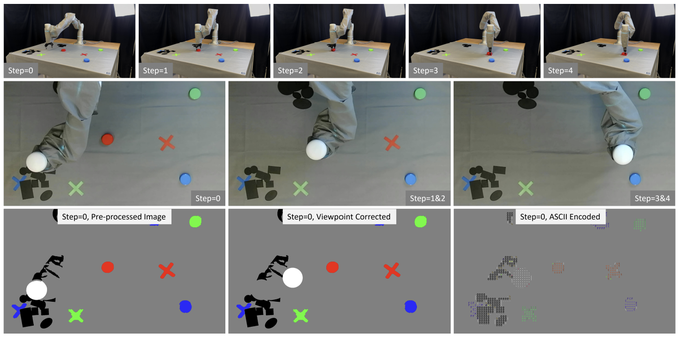
Vision–Language–Action (VLA) controllers are often built by extending vision–language models (VLMs) with action supervision, relying on multimodal backbones with large data and compute requirements. We demonstrate that a text-only large language model (LLM) can be adapted into a VLA-style controller when visual observations are rendered into a text input using an ASCII representation. This ASCII-as-vision interface enables existing training and deployment stacks for LLMs to efficiently condition on visual state, follow natural-language instructions, and produce constrained, executable actions. We fine-tune and compare multiple LLMs and VLMs across model families and scales, using both expert demonstrations from a planning-based teacher, as well as DAgger for iterative improvement. In a 2D manipulation benchmark, in both simulation and on a physical manipulator, the resulting controllers can identify task-relevant entities and plan feasible action sequences. Our results suggest that ASCII rendering can serve as a lightweight, interpretable modality bridge from images to text, complementing conventional VLA pipelines, and opening directions for VLA research with text-only backbones.